Compress PDF — Reduce PDF File Size Free Online
Compress a PDF with an adjustable quality preset and compare the output file size.
Drop a PDF here — get a smaller file that fits your upload limit
How to compress a PDF so it is smaller for email and upload forms
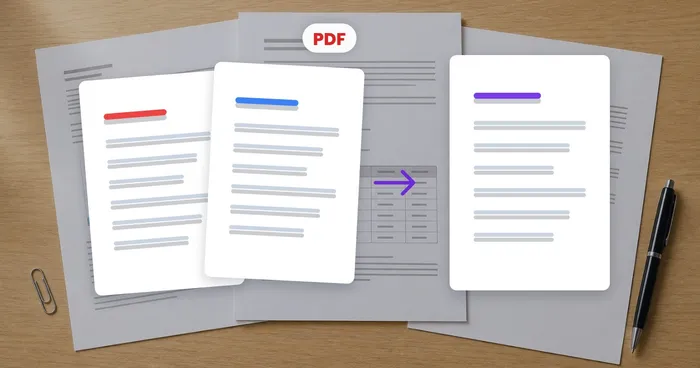
This PDF compressor can optimize PDF files for sharing by reducing the resolution of the images inside them and tidying the file structure. Choose one of four quality levels, run it, and compare the before and after sizes before you download. It suits scanned documents, photo-heavy reports and other PDFs that are too large to email or upload, and it works in any browser without an app.
How to compress a PDF on Mac or Windows and pick a level
The Compression level lets you lower the resolution of a PDF's images by different amounts: Screen (smallest) uses 72 DPI, E-book 150 DPI, Printer 300 DPI and Prepress 300 DPI at the largest size. Printer is selected when you open the page. After you select Compress PDF, the result shows the Before and After sizes. Changing the level clears the result, so run it again to compare.
- Upload the PDF you want to shrink.
- Pick a compression level, starting with E-book or Printer.
- Select Compress PDF and compare the Before and After sizes.
- Try Screen (smallest) if the file is still too large.
- Choose See result, then download the compressed PDF.
How to make a PDF smaller to email or upload to a form
To decrease the size of a PDF for email, start with Screen or E-book, and check your mail service's attachment limit before you send. Scanned pages and photo-heavy PDFs shrink most, because nearly all of their size is image data. A PDF that is mostly text is already small and may barely change. The result is not larger than your original, because the tool returns the smaller of the compressed file and the file you uploaded.
Choose a level by how the PDF will be used
For a file that will only be read on a screen or attached to an email, Screen (smallest) at 72 DPI gives the biggest reduction, and E-book at 150 DPI keeps more detail for reading. For a document people will print, stay with Printer or Prepress, which keep images at 300 DPI. Run the file once at your first choice and read the After size: if it already fits, there is no need to go lower.
Reduce PDF file size without losing quality: what to expect
This is not lossless PDF compression: lowering image resolution gives up some picture detail, and Screen gives up the most. Printer and Prepress reduce images no lower than 300 DPI, which holds up for printing, and Prepress keeps the most detail at the largest size. Pages are not turned into pictures, so text that is selectable in the original stays selectable where the file supports it. Check a page or two in the result before you send it.
What to do when the file is still too large
There is no field for an exact size such as 300 KB or 1 MB, so the way to a limit is to try the smaller levels and read the After size. If Screen is not enough, split the PDF into parts that each fit under a size limit with the By file size mode. If the PDF comes from your own scans, build it again with a lower Quality setting to start smaller. A PDF that is already compressed may not shrink further.
Before you compress
- Keep the original PDF, because the compressed copy has lower image resolution.
- Merge the files first, then compress the finished document, so the size you check is the size you send.
- This tool only shrinks a PDF that already exists, so turn a Word file into a PDF or build one from pictures first.
- Open the compressed PDF and scroll through it before you send it, especially pages with small print or photos.
- Batch mode compresses many PDFs at one level into a single ZIP, and it is a Premium feature.
If the compressed PDF is still over the limit
There is no exact size target, so when a portal still rejects the file, send only the pages it asks for or delete pages it can do without. Photos that are not a PDF yet are easier to control: shrink each image toward a size like 100KB, then assemble them into one PDF.
Compress a PDF for email and check the attachment
Use the recipient's actual attachment limit. The complete message may include other files, and an email service can apply its own limits. Keep your original PDF separately.
- Upload a working copy. Try E-book for screen reading, or Printer when fine scan detail matters, then compare the before and after file sizes.
- Open the downloaded PDF. Check every page, small print, reference numbers and any visible handwritten signature at a readable zoom.
- Attach the reviewed copy and confirm it opens from the draft message. If it remains too large at a readable quality, use a sharing method the recipient accepts.
A visible signature in a scan is different from a certificate-based digital signature. This compressor does not promise to preserve digital signatures. Use the issuer's approved process for signed or locked documents. Already compact PDFs may not shrink.
Review scanned PDF detail and signature checksWhat you can do with Compress PDF
Review the main capabilities before you begin.
- Shrink PDF file size for email attachments
- Compress a PDF to fit form upload limits
- Pick a quality preset to balance size and clarity
- Make a heavy scanned PDF lighter to share
- Reduce document size without splitting pages
Settings reference
2 settings
Available controls for Compress PDF.
- Processing modePresets
- Process one input, or switch to Premium batch mode to process multiple inputs with shared settings. Available input types depend on the tool.Options: Single PDFBatch
Quality
- Compression levelPresets
- Picks how strongly embedded images are downsampled, from Screen (72 DPI, smallest file for on-screen viewing) through E-book (150 DPI) to Printer and Prepress (300 DPI) for print-quality output; the PDF recompresses automatically when changed.Options: Screen (smallest)E-bookPrinter (300 DPI)Prepress (largest)
Related tools for Compress PDF
Tools for common next steps after Compress PDF.
PDF & Documents
Merge PDF
Combine multiple PDFs, arrange them in the required order and download one merged file.
Try it nowPDF & Documents
Split PDF
Split a PDF by page range, at regular intervals or into single pages. Download the files separately or as a ZIP.
Try it nowPDF & Documents
Organize PDF
Reorder, extract or remove PDF pages using visual thumbnails, then download the revised document.
Try it nowFrequently Asked Questions
How Compress PDF helps you get it done
Real problems it solves every day — for businesses, creators, and everyday tasks. Find the use case that fits you and start.
Email-Friendly Attachments
Email providers apply attachment limits that vary by service and account. Compress a scanned PDF, compare the result size and verify readability before sending.
Government Portal Uploads
IRS, immigration, court and licensing portals often impose tight upload size limits (5MB, 10MB). Compress to fit before the deadline-driven upload fails.
Mobile-Friendly Document Sharing
Reduce large PDFs for mobile recipients, then verify that text and images remain suitable for the presentation.
Archive Storage Efficiency
Long-term archives of thousands of PDFs add up to terabytes. Compress every PDF on ingestion to cut archival storage cost by 60-90%.
Faster Cloud Sync
Smaller PDFs sync faster across Dropbox, Google Drive, OneDrive and iCloud. Especially useful for team workflows that share documents constantly across devices.
Print-Ready Distribution
Compress oversized brochures and product catalogs before distributing for in-store print. Most print kiosks accept compressed PDFs and the quality remains print-acceptable at the Printer or Prepress preset.
Job Application Portals With Strict Upload Caps
When a job portal sets a PDF upload limit, use the Printer preset to reduce a scanned reference letter or portfolio, then review image clarity before submitting.
Real Estate Listing Brochures & MLS Uploads
Photo-heavy property brochures often exceed MLS or listing-portal size limits — compress at the Printer preset to keep photos presentable while emailing or uploading listings on a deadline.
Legal E-Filing Systems With Per-Document Limits
Court e-filing systems commonly cap each PDF exhibit at 10-25MB — compress scanned exhibits or discovery documents at the Screen or E-book preset to file on time without splitting the document.
Course & LMS Assignment Uploads
Canvas, Blackboard and Google Classroom impose per-file upload limits — students can compress a scanned handwritten assignment or an image-heavy design portfolio at the E-book preset before a submission deadline.
Self-Publishing Manuscript & eBook Uploads
KDP, IngramSpark and similar self-publishing platforms enforce PDF size limits for interior files — compress an illustration-heavy manuscript at the Prepress preset to keep artwork crisp while meeting the upload cap.
Email Attachment Size Limits for Business Correspondence
Gmail, Outlook and most corporate mail servers cap attachments around 20-25MB — compress an invoice batch, scanned contract or image-heavy report at the E-book or Printer preset so it clears the limit and doesn't bounce back to the sender.
Guides for this tool
- The Application Is Finished. The PDF Is Too Large to Submit.A finished application can still fail at a PDF upload limit. Explore Pixoate compression and page review to prepare a smaller, readable submission.
- Compress a PDF for an Application Upload LimitReduce a PDF for an application portal, compare quality presets and check every page. Learn what to do when a readable document still exceeds the upload limit.
Watch each transformation land
Every photo crosses the slash untouched and comes out the other side finished.