Image to Word Converter — Convert JPG to Word DOCX
Drop a photo, screenshot or scan and download a .docx with the picture placed on the page, sized to fit — ready to caption, print or hand in.
Upload Image
Drop an image — download a Word (.docx) file with the picture inside.
All image formats (JPG, PNG, WEBP, HEIC, TIFF…)
How do I convert an image to a Word document?
Decide what the .docx should hold. The picture, the default, places your image on one page, scaled to fit with its proportions kept, ready for captions around it. The text (OCR) reads the words and writes each line as an editable paragraph, with engine and language settings. Upload the image, convert it, then download the document.
| The picture (default) | Your image embedded in a new .docx, sized to fit one page; no text is recognized |
|---|---|
| The text (OCR) | Recognized lines become editable paragraphs; choose the engine and source language |
| Opens in | Microsoft Word, Pages, Google Docs and other office apps |
| Switching mode | Keeps your upload, so the same image can be converted the other way |
| Many images at once | Premium handles up to 60 files per batch and Pro up to 200; each image becomes its own .docx inside one ZIP |
Convert image to Word document: keep the picture or edit its text
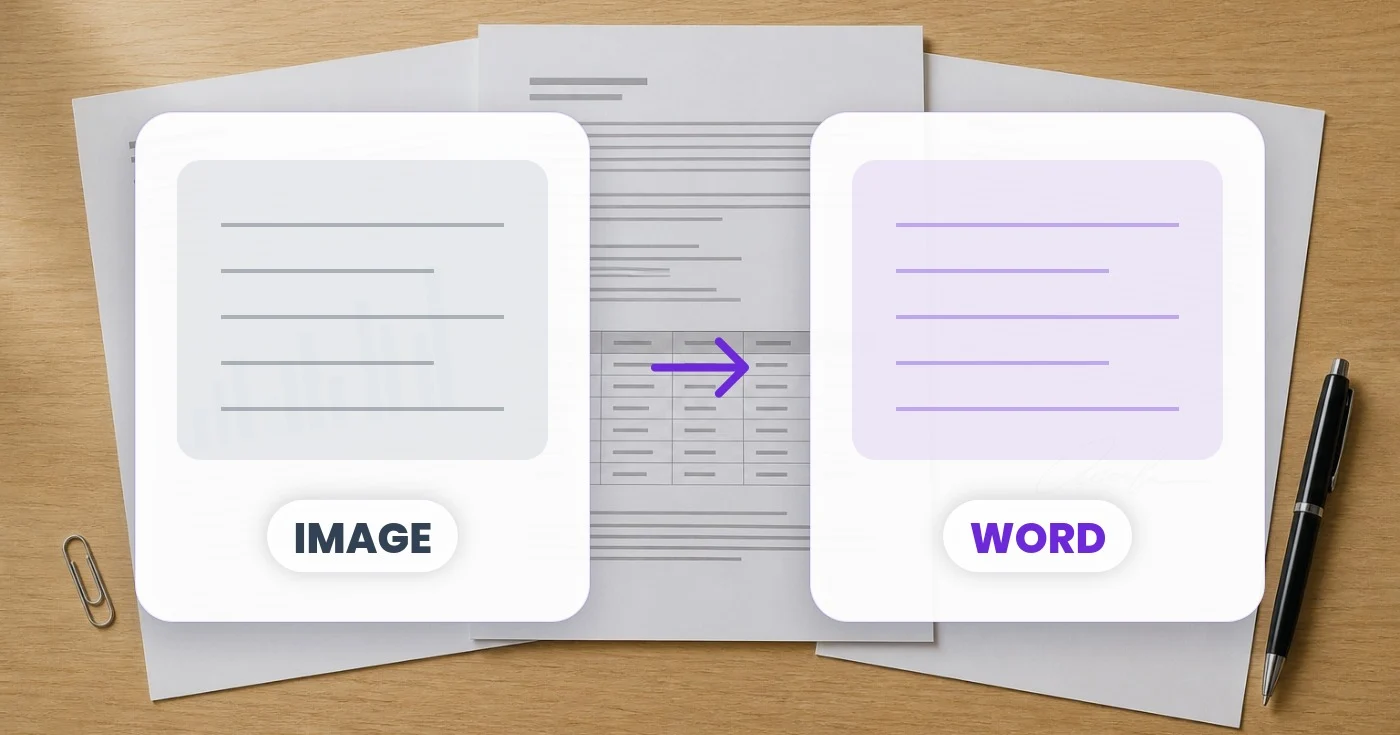
This image to Word converter builds a new .docx from a JPG, PNG or other image, and the first choice on the page decides what goes inside. The picture mode places your image on a page of the document, ready to caption or print. The text mode reads the words in the image and writes them as editable paragraphs. Pick a mode, convert the file, then open the result in Word, Google Docs or Pages.
Put a JPG, PNG or screenshot into a Word .docx
For a JPG to Word or PNG to Word conversion, leave What should the Word file contain? on The picture, which is the default. Your image is embedded on page 1 of a fresh .docx, scaled to fit with its proportions kept, and no text recognition runs. Phone photos keep their upright orientation. It suits a photo for a report, a signed form to attach or a work instruction, and as a photo to Word converter it takes a screenshot with the same steps.
- Drop a JPG, PNG, WEBP or other image onto the upload area.
- Keep The picture selected under What should the Word file contain?
- Choose Convert file and wait for the ready message.
- Select See result, then download the .docx.
Change a JPG, JPEG or PNG to Word with the same steps
To convert JPG to Word, upload the file and choose Convert file; the tool writes a new document, so your original is not altered. A JPEG goes through the same steps, so you can convert from JPEG to Word one image at a time, and a PNG gives the same kind of .docx as a JPG does. Whatever the file type, the only choice is whether the image goes in as a picture or as text. As an online JPG to Word converter it opens in a browser on a phone or a computer.
Turn a scanned image or page photo into editable Word paragraphs
To OCR JPG to Word, switch to The text (OCR) and the Engine and Language settings appear. Set Language to the language printed on the page, then choose Convert file. This text mode is a Word export: Premium includes it, and other accounts sign in to use their export allowance, then credits. Each recognized line becomes its own paragraph in the new .docx. Headings, bullets, tables and bold or italic styling are not rebuilt, so expect to restyle the document in your word processor. Neat printed pages read most reliably; for handwriting, use the handwriting reader and paste its text into Word.
What the new Word file contains
You get one new .docx per image. For a signed form, a whiteboard shot or a screenshot it works as a photo to document converter: one image in, one new document out. It is not a layout-preserving converter, so text mode gives plain paragraphs and you restyle them in your word processor after you open the file. The file it writes is a .docx, which Word, Google Docs and Pages open, not the older .doc format.
Convert several page photos or a scanned PDF to Word
Each run takes one image and makes one document, and batch mode returns a separate .docx per image in a ZIP. To end up with a single multi-page file, combine the page photos into one PDF, then open it in PDF to Word. Its Keep the exact appearance option places every page in Word as a picture, so scans work but their text is not editable; Edit the content suits PDFs that already have selectable text. If you only need the words and no Word file, copy or save the recognized text.
Before you convert
- Decide whether the document needs the picture itself or the words in it.
- In text mode, set Language to match the page before you choose Convert file.
- Use a sharp, upright image; a straight-on scan reads better than an angled photo.
- Open the .docx and check names, numbers and line breaks before you send it on.
When a .docx is not the right container
If you only need the words, copy the recognized text or save it as .txt, and for handwritten notebook pages, use the reader built for handwriting. A source that is already a PDF goes through PDF to editable Word, several page photos can be bound into one multi-page PDF, and a screenshot meant for the web can be rebuilt as an HTML page.
What you can do with Image to Word
Review the main capabilities before you begin.
- Place a photo or screenshot inside a .docx page
- Keep the picture whole — scaled to fit, proportions intact
- Or switch to OCR and extract the text instead
- Turn scanned pages into a Word file you can edit
- Recognize text in your document's language
Settings reference
4 settings
Available controls for Image to Word.
- Processing modePresets
- Process one input, or switch to Premium batch mode to process multiple inputs with shared settings. Available input types depend on the tool.Options: Single fileBatch
Mode
- What should the Word file contain?Presets
- Chooses which of the two jobs the tool does: The picture (the default) places your image itself on the page of a .docx, scaled to fit, with nothing recognized or retyped; The text (OCR) reads the words out of the image and writes them as editable paragraphs instead. The Engine and Language settings below appear only in text mode.Options: The pictureThe text (OCR)
Settings
- EngineDropdown
- Chooses which text-recognition engine reads your image; keep Default for most photos and scans, or try Engine 1 or Engine 2 if some words come out wrong.Options: DefaultEngine 1Engine 2
- LanguageDropdown
- Choose the main language in the source. The available choices depend on the selected reader; unsupported languages are hidden. English is the default. Review the extracted text for recognition errors.Options: EnglishFrenchGermanSpanishItalianPortugueseDutchRussianJapaneseKoreanChinese (Simplified)Chinese (Traditional)ArabicHindiBengaliPunjabiUrduVietnameseThaiPolishSwedishDanishNorwegianFinnishTurkishUkrainianIndonesianTamilTeluguMarathiNepaliPersianGreekHebrew
Related tools for Image to Word
Tools for common next steps after Image to Word.
OCR & Data Extraction
Image to Text (OCR)
Extract editable text from a screenshot, photo or scan in 30+ supported languages.
Try it now
PDF & Documents
Image to PDF
Combine images into a multi-page PDF. Optionally add recognized text for search and copying.
Try it now
OCR & Data Extraction
Image to Markdown
Convert a screenshot or photo into Markdown text, with tables rebuilt as pipe tables.
Try it nowFrequently Asked Questions
How Image to Word helps you get it done
Real problems it solves every day — for businesses, creators, and everyday tasks. Find the use case that fits you and start.
Drop a Photo into a Report
Place a site photo, product shot or whiteboard picture straight onto the page of a .docx, sized to fit, then write the report around it instead of wrestling with Word's image placement.
Attach a Screenshot to a Work Instruction
Turn a screenshot of an error, a settings screen or a dashboard into a Word document you can annotate, caption and send to support, IT or a client.
Edit Old Letters and Memos
Convert photographs of old typed letters, memos and corporate correspondence into editable Word documents so you can update them, redact sensitive parts and reuse the templates.
Quote and Proposal Templates
Sales teams convert printed proposal templates into editable .docx files so they can customize quotes per client without retyping the boilerplate clauses.
Resumes from Old Print Versions
Job seekers convert photos of their old printed resumes into editable Word documents to update job titles, dates and achievements without rebuilding the layout from scratch.
Manuscript Drafts from Notebooks
Writers and journalists convert photographed notebook pages and printouts into Word drafts they can edit, structure into chapters and submit to editors or self-publish.
Translate-Then-Edit Foreign Documents
Translators convert foreign-language scans into Word, run them through a translator, and finalize the edit in their usual Word workflow with track-changes and comments.
Court Filings and Legal Drafts
Paralegals convert photographed court filings, exhibits and case law printouts into Word so attorneys can excerpt them into briefs and motions without retyping every paragraph.
Insurance Claim Forms
Convert photographed insurance claim forms and supporting documents into editable Word files so applicants can complete, sign and submit them digitally.
Student Essay Drafts
Students convert handwritten essay drafts and exam answers into Word for revision, citation formatting and submission to teachers or online plagiarism checkers.
Recipe Card Cookbook Drafts
Digitize a shoebox of handwritten family recipe cards into one editable Word document, ready to format into a printed or PDF family cookbook.
Recreate Old Government or School Forms
Turn a photographed paper form — a permission slip, permit or intake form — into an editable Word template you can update and reprint instead of rebuilding the layout from scratch.
Meeting Minutes from Whiteboard Photos
Photograph a whiteboard or flip-chart from a meeting and convert the notes into an editable Word doc you can clean up, format and circulate the same day.
Refresh an Old Newsletter or Bulletin
Convert a scanned church bulletin, club newsletter or alumni magazine page into editable Word so you can update it for a new issue without rebuilding the layout by hand.
Guides for this tool
- How to Convert Image Text to PDF: Searchable Pages or Editable TextTurn image text into a searchable PDF or an editable document. Compare both Pixoate workflows and choose the right output for your paperwork.
- How to Convert Handwritten Job Notes into Editable Text and Client PDFsTurn handwritten job notes into editable text and client PDFs with Pixoate. Preserve service details, clarify uncertain words and keep source evidence.
Watch each transformation land
Every photo crosses the slash untouched and comes out the other side finished.