
How to Sell an Empty House Without Buying Furniture
Prepare, photograph and present a vacant home so buyers can picture it, and learn where virtual staging helps and how to label it honestly.
Written by the Pixoate team. We check how each tool behaves before we describe it, and we date any prices or portal rules we quote.
To sell an empty house without buying furniture, prepare and photograph it well, show a furnished concept for the two or three rooms buyers struggle to read, label that concept clearly and keep the empty originals.
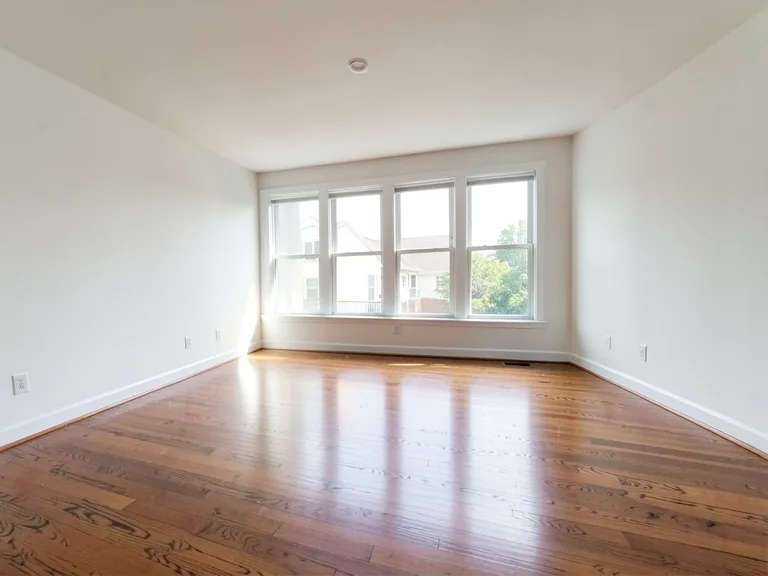
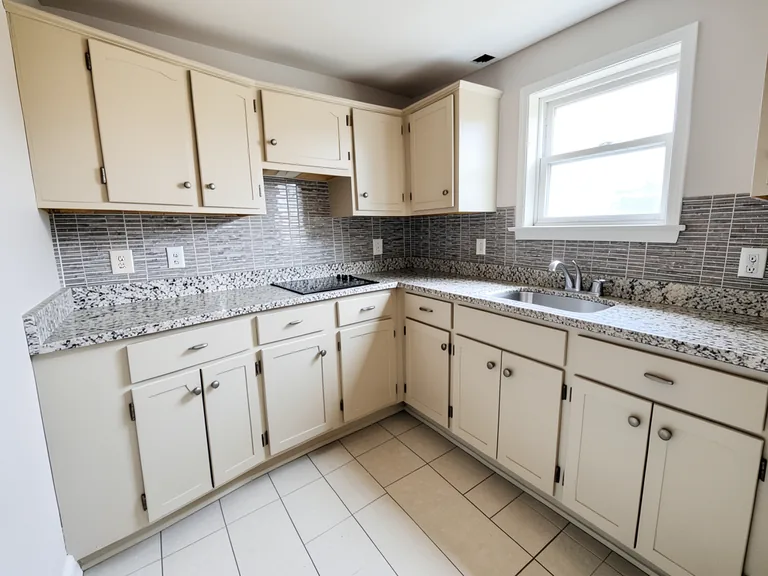
An empty house photographs as a set of boxes. Buyers walk through listing photos in seconds, and a bare room gives them nothing to measure a sofa, a bed or a desk against. They cannot tell whether the lounge is generous or cramped, so many simply scroll on.
You do not have to buy or rent furniture to fix that. This guide covers what to do before the photos, how to show an empty property honestly, and where virtual staging fits in.
If you only do five things
- Get the house clean, bright and repaired before anyone takes a photo.
- Photograph every room from a natural height, in daylight, with the lights on.
- Pick the two or three rooms whose purpose is hardest to read and show a possible layout for them.
- Label any digitally furnished image as virtually staged, and keep the empty originals.
- Check the result against the real room before it goes into a listing.
Why empty rooms are hard to sell
Buyers judge a room by what they can compare it to. In an empty room there is no bed to show whether a main bedroom fits a double or a king, and no dining table to show whether the dining area works. Odd shapes such as a narrow room, an alcove or a room with three doors look smaller and stranger than they are.
Surveys of agents suggest that staging in general helps buyers engage with a home; NAR's 2025 staging report is the most cited recent example. Treat it as context rather than proof. It records agents' impressions, it is about staging broadly rather than virtual staging, and it says nothing certain about your property. The figures and their caveats are set out in the USA cost guide below.
Get the basics right first
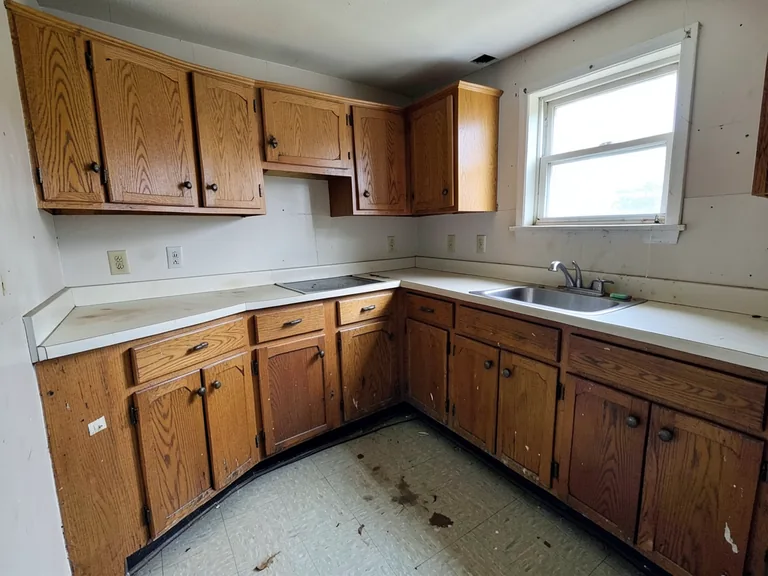
Furniture, real or digital, will not rescue a dirty or dim house. Before any photos:
- Deep clean floors, windows, kitchen and bathrooms, and clear marks from walls.
- Repair what a buyer will notice: dripping taps, cracked tiles, loose handles, flaking paint.
- Replace dead bulbs and open every curtain or blind.
- Take out leftover clutter. If boxes or tools are in shot, remove temporary clutter from the photo rather than leaving it to distract.
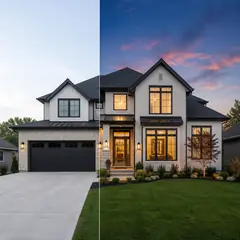
- Keep the garden and entrance tidy, because the front of the house is usually the first picture.
How to photograph an empty property
- Shoot in daylight and turn all lights on, so rooms look warm instead of flat.
- Stand in a corner at about chest height and keep the camera level, so walls stay straight.
- Take one wide view per room, plus a close shot of any feature, such as a fireplace, built-in storage or a view.
- Avoid extreme wide-angle settings. They stretch the room, and that stretch carries into any furniture you add later.
- Photograph the same room from two angles if one is awkward. You can pick the better one afterward.
Three empty rooms, three different jobs
It helps to think about what each empty room has to prove, because that decides what you show.
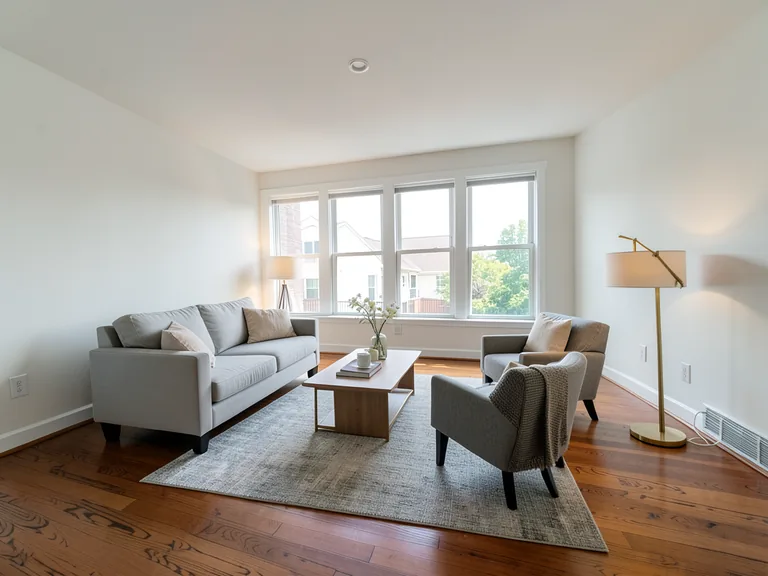
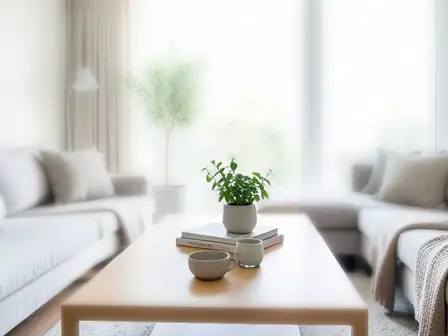
The living room has to prove that people can actually live there. Buyers want to see where a sofa goes, whether a television and a seating group can coexist, and how you walk from the door to the window. A bare rectangle gives none of that, so this is almost always the first room worth showing furnished.
The main bedroom has to prove that a real bed fits comfortably with space left over. Buyers carry a mental picture of their own bed, and an empty room makes it hard to test it. A double bed with two side tables and clear floor on both sides answers the question in one glance.
The spare room is the interesting one, because its job depends on who is likely to buy. In a family neighborhood near schools, a child's bedroom or a nursery might land well. In a city flat, a home office often does more work, since many buyers now ask whether there is somewhere to work from home. If you are not sure, ask your agent what questions buyers keep asking at viewings and answer the most common one.
Kitchens and bathrooms are fixed spaces with obvious uses, so they rarely need furniture. Spend your effort elsewhere.
Where virtual staging helps
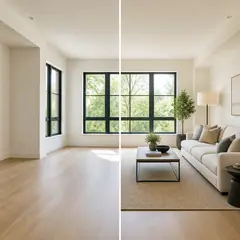
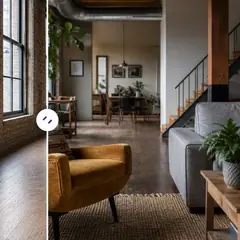
Virtual staging adds furniture to a photo of the real room. It works best where a buyer needs to understand scale or purpose: the main living space, the main bedroom, a spare room that could be an office, or a dining area with no obvious spot for a table.
With Pixoate Virtual Staging AI, you upload the empty-room photo and choose a direction such as living room, bedroom, home office, dining room, kids room, nursery, guest bedroom, studio apartment, entryway or basement. You can also add items such as a rug, curtains, wall art or a floor lamp, and write your own instruction. Then compare the generated concept with the original.
A good instruction asks for restraint: "Stage this empty room as a modest living room with proportionate furniture and neutral decor. Keep the windows, doors, flooring and camera angle unchanged." A step-by-step walkthrough of staging a single room is in how to stage an empty room for listing photos.
Check the result like a buyer would
Instructions guide the model, but they cannot promise every detail stays the same. Before using any image:
- Look at windows, doors, radiators and ceiling lines. They must match the original.
- Make sure the furniture is plausible for the floor area and does not block a doorway.
- Check that nothing hides a mark or defect that is really there.
- Reject any item that implies something the house does not include, such as a built-in feature or a light fitting.
- If you stage the same room more than once, keep one consistent concept, or present the views as alternatives.
Furniture shown in an image is a visual idea, not a measurement. Measure the room if a buyer asks whether a particular bed will fit.
What happens when a buyer walks in
The most useful way to judge any staging approach is to imagine the viewing. A buyer saw a furnished living room online, drove across town and now stands in an empty one. If the photo made the room look twice its size, they feel misled in the first ten seconds, and a buyer who feels misled negotiates harder or leaves.
You can avoid that. Keep the staged furniture honest in scale, put an unstaged photo of the same room into the gallery so people can see the bare space, and mention in the description that some images are virtually staged. If your agent prints feature sheets for viewings, add a line there as well. Buyers tend to forgive digital furniture they were told about and resent furniture they discovered.
A few mistakes show up again and again in staged photos, so look for them when you review your own:
- Furniture that is too large for the room, which makes the room look bigger than it is.
- A style that does not match the price bracket, such as ultra-luxury pieces in an entry-level flat.
- Different styles in different rooms of the same home, which makes the set look pasted together.
- Rugs or sofas that seem to float because the shadows do not match the light from the window.
- Pieces blocking a doorway, a radiator or a built-in cupboard that buyers will want to open.
Be open about what is staged
Show buyers what is real. Keep the empty photograph, label any digitally furnished version with a line such as "Virtually staged; furniture shown is illustrative," and use both where the listing allows. Rules differ between listing services, brokerages and countries, so check the requirements that apply to you. For more on the trade-offs, see virtual staging compared with traditional home staging.
Costs by country
If you are comparing options, start with what staging costs in the USA; the UK and Australian guides are linked from there.
What to do next
If the house is also dated, consider whether a few changes would help more than furniture. You can preview a renovation before spending money to decide whether new paint or flooring is worth it before you list.
Related guides
For the wider picture, see our guide to real estate listing photos.
Frequently asked questions
Is virtual staging cheaper than renting furniture?
For a vacant property it usually costs less than renting and moving real furniture, because there is no delivery, storage or removal. Prices vary, so compare quotes for your market instead of relying on a general figure.
Do I have to tell buyers a photo is virtually staged?
Be transparent. A short caption and the original photo protect buyers and you. Local listing rules and brokerage policies can require specific wording, so confirm them before you publish.
Which rooms should I stage first?
Start with the living area, the main bedroom and any room whose use is unclear. Kitchens and bathrooms are fixed spaces, so buyers can usually read them without help.
Will staging sell my house faster?
Nothing in this guide promises that. Price, condition, location and the quality of the listing matter most. Staging helps buyers understand a room, which can make a listing easier to engage with.
One well-judged furnished room usually does more than ten rushed ones. If you want to see whether it helps your own listing, staging the room buyers will struggle with most is the cheapest experiment you can run.