Convert ORF to JPG — Free Online ORF Converter
Convert ORF to JPG online at full resolution. Open camera RAW files without Photoshop or Lightroom; preview one free or batch-convert with Premium.
Drop your ORF file or click to browse
Why convert ORF to JPG?
- JPG is supported far more widely than ORF, so the file is easier to open, share and upload.
- JPG is made for photos you share, email, print or upload.
- No Photoshop or Lightroom needed: the file is opened on our servers and you download a ready-to-use JPG.
What to expect when converting ORF to JPG
- JPG uses lossy compression; raise the quality in Settings for a closer copy of the original.
- The RAW file is developed at full resolution with your camera's white balance. Keep the original ORF to re-edit exposure later.
ORF vs JPG
| Feature | ORF | JPG |
|---|---|---|
| Full name | Olympus camera RAW | JPEG (Joint Photographic Experts Group) |
| Origin | Written by Olympus cameras | Standardised in 1992 |
| Compression | Unprocessed sensor data | Lossy, adjustable quality |
| Transparency | No | No |
| Animation | No | No |
| Color | 12 to 16 bits per channel from the sensor | 16.7 million colors (8 bits per channel) |
| Where it opens | RAW editors such as Lightroom; not browsers or most apps | All browsers, phones, computers and photo apps |
| Best for | adjusting exposure and white balance with maximum latitude | photos you share, email, print or upload |
| Main drawback | very large files that most apps can't open | no transparency, and every re-save loses a little more detail |
In short: choose ORF for adjusting exposure and white balance with maximum latitude; choose JPG for photos you share, email, print or upload.
ORF to JPG for Olympus and OM System cameras
ORF files come from Olympus cameras, from early E-series bodies through the OM-D and PEN lines and the Tough TG compacts, and from OM System models made since the camera business changed hands. Whatever the age of the body, the file is converted the same way here.
What surprises Olympus shooters most is that the look chosen in the camera doesn't carry over. Picture Modes, Art Filters and monochrome settings are applied to the camera's own JPG, while the ORF keeps full-color sensor data. The converter develops that data with the recorded white balance and automatic brightness, so a Grainy Film or Monochrome frame comes out in natural color. To get the black-and-white version back, turn the converted JPG black and white afterward.
Olympus sensors have a 4:3 shape. If you set the camera to 16:9 or 1:1, the RAW still records the whole sensor, so the JPG may show more than the framing you composed; crop it back to that shape. High Res Shot composites are far larger than normal frames and may not fit the upload size for your plan. For a quick email, compress the result to about 200 KB.
Frequently asked questions
- How do I convert ORF to JPG?
- Upload your ORF file above. It is converted to JPG automatically (change the output format or quality in the Settings tab if you need to), then click Download. There is nothing to install.
- Does converting ORF to JPG lose quality?
- JPG is lossy, so some fine detail is discarded to make the file smaller. Raise the quality in Settings for a closer copy.
- ORF or JPG: which should I use?
- Use ORF for adjusting exposure and white balance with maximum latitude. Use JPG for photos you share, email, print or upload. Keep in mind the main drawback of JPG: no transparency, and every re-save loses a little more detail.
- What is a ORF file?
- ORF is the RAW format of Olympus and OM System cameras. It stores the unprocessed sensor data for maximum editing latitude, so most apps can't show it as a normal picture.
- Can I convert ORF to JPG without Photoshop or Lightroom?
- Yes. The ORF file is opened on our servers, so you don't need Photoshop or Lightroom or any other software installed. Upload the file, then download the finished JPG.
- Is the ORF to JPG converter free?
- Yes. Convert, preview and download a single result without creating an account. Premium adds batch conversion (many files into one ZIP) and larger uploads.
What you can do with ORF to JPG
Review the main capabilities before you begin.
- Convert Olympus ORF raw photos to JPG
- Open camera raw files anywhere as standard JPGs
- Adjust JPG quality to balance size and detail
- Set a background fill color for your images
- Convert many ORF shots at once in batch
- Share raw camera photos without special software
Settings reference
5 settings
Available controls for ORF to JPG.
Settings
- Output formatDropdown
- Chooses the file type you download. The page opens on its own output format; switch to any other format before converting.Options: JPGPNGWebPAVIFGIFTIFFBMPICOPDF
- QualitySliderRange: 20–100 · Default: 90
- For JPG, WebP, AVIF and image-to-PDF output: higher keeps more detail but makes a bigger file; 60–80 suits most photos. Documents (Publisher, XPS, EPS…) become PDFs with every page and sharp text, with no quality setting.
- Lossless modeOn / Off
- For WebP and AVIF output: keeps every pixel exactly (best for logos, graphics and transparency) at the cost of a larger file.
- Background fillColor picker
- For JPG, BMP and image-to-PDF output, which can't store transparency: the color that fills transparent areas (white by default).
Mode
- Single file / BatchDropdown
- Process one file or a batch with shared settings. Batch results download as one ZIP.Options: Single fileBatch
Related tools for ORF to JPG
Tools for common next steps after ORF to JPG.
Image Conversion
ORF to PNG
Convert ORF files to PNG. Review and download the converted image.
Try it now
Image Conversion
Image Format Converter
Convert between supported PNG, JPG, WebP, AVIF and GIF formats, then review and download the result.
Try it now
Photo Editing & Utilities
Compress Image to KB
Compress JPG, PNG or WebP files toward a chosen size such as 20KB, 50KB or 100KB, then review the result.
Try it nowWatch each transformation land
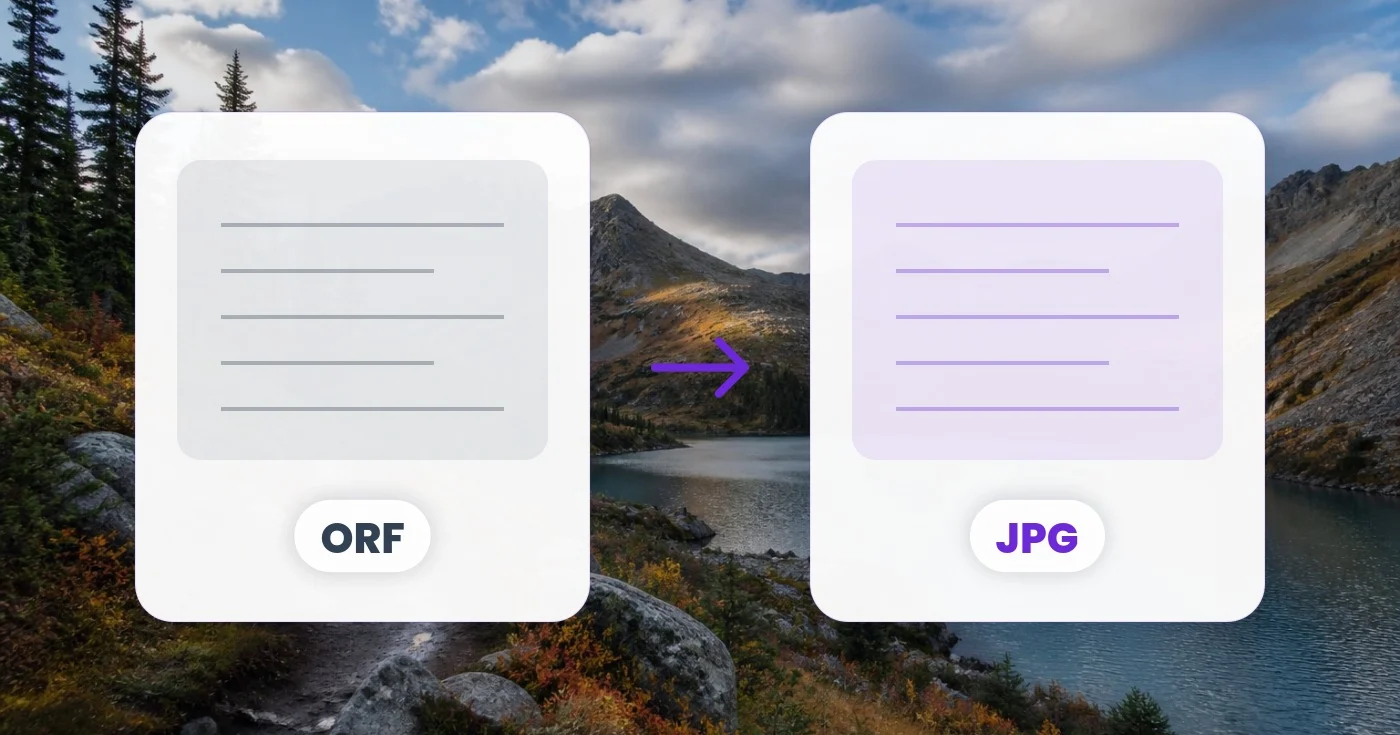
Every photo crosses the slash untouched and comes out the other side finished.