Convert HEIC to WebP — Smaller Images for Faster Sites
Convert HEIC to WebP online for smaller, faster-loading web images. No software to install. Preview one free or batch-convert with Premium.
Drop your HEIC file or click to browse
Why convert HEIC to WebP?
- WebP is supported far more widely than HEIC, so the file is easier to open, share and upload.
- WebP is made for websites, online stores and blogs that need fast-loading images.
What to expect when converting HEIC to WebP
- WebP uses lossy compression by default; raise the quality or switch on lossless in Settings for a closer copy.
- High-dynamic-range and wide-color detail is converted to standard 8-bit color.
HEIC vs WebP
| Feature | HEIC | WebP |
|---|---|---|
| Full name | High Efficiency Image Container | WebP |
| Origin | Apple's default photo format since iOS 11 (2017) | Released by Google in 2010 |
| Compression | Lossy (HEVC) | Lossy or lossless |
| Transparency | Not in iPhone photos | Yes — smooth, partial transparency |
| Animation | No | Yes |
| Color | 8 or 10 bits per channel, wide color | 8 bits per channel |
| Where it opens | Apple devices; many Windows PCs, Android apps and websites need extra software | All current browsers; some older desktop apps and upload forms reject it |
| Best for | saving storage space on iPhones and iPads | websites, online stores and blogs that need fast-loading images |
| Main drawback | limited support outside Apple devices | older apps and some upload forms don't accept it |
In short: choose HEIC for saving storage space on iPhones and iPads; choose WebP for websites, online stores and blogs that need fast-loading images.
Putting iPhone HEIC photos on a website as WebP
iPhones save photos as HEIC by default, and most browsers outside Safari can't display HEIC, so the photos can't go straight onto a website. WebP is a natural destination: every current browser shows it, and it keeps files small.
A full-size iPhone photo is far larger than any web layout needs. Resize it to the width your page displays, then convert; the pixel count affects file size more than the quality setting does. Quality 75 to 85 is a reasonable range for photos on the web, and Lossless mode is rarely useful for camera pictures.
Along the way the photo is converted to standard 8-bit color, so any extra color range the HEIC carried is not kept. If you are sending photos to people rather than publishing them, convert HEIC to JPG instead, which every phone and computer opens. To stop new photos arriving as HEIC, choose Most Compatible under Camera, then Formats, in the iPhone's Settings app.
Frequently asked questions
- How do I convert HEIC to WebP?
- Upload your HEIC file above. It is converted to WebP automatically (change the output format or quality in the Settings tab if you need to), then click Download. There is nothing to install.
- Does converting HEIC to WebP lose quality?
- WebP is lossy by default, so some fine detail is discarded to make the file smaller. Raise the quality or switch on lossless in Settings for a closer copy.
- HEIC or WebP: which should I use?
- Use HEIC for saving storage space on iPhones and iPads. Use WebP for websites, online stores and blogs that need fast-loading images. Keep in mind the main drawback of WebP: older apps and some upload forms don't accept it.
- What is a HEIC file?
- HEIC is how iPhones and iPads save photos by default. It needs up to half the space of a JPG at similar quality, but many Windows PCs, Android apps and websites still can't open it.
- Is the HEIC to WebP converter free?
- Yes. Convert, preview and download a single result without creating an account. Premium adds batch conversion (many files into one ZIP) and larger uploads.
What you can do with HEIC to WebP
Review the main capabilities before you begin.
- Convert HEIC files to WebP online
- Choose WebP quality or switch to lossless
- Switch to any other output format in Settings
- Batch-convert many HEIC files into one ZIP
- Preview the result before you download
Settings reference
5 settings
Available controls for HEIC to WebP.
Settings
- Output formatDropdown
- Chooses the file type you download. The page opens on its own output format; switch to any other format before converting.Options: JPGPNGWebPAVIFGIFTIFFBMPICOPDF
- QualitySliderRange: 20–100 · Default: 90
- For JPG, WebP, AVIF and image-to-PDF output: higher keeps more detail but makes a bigger file; 60–80 suits most photos. Documents (Publisher, XPS, EPS…) become PDFs with every page and sharp text, with no quality setting.
- Lossless modeOn / Off
- For WebP and AVIF output: keeps every pixel exactly (best for logos, graphics and transparency) at the cost of a larger file.
- Background fillColor picker
- For JPG, BMP and image-to-PDF output, which can't store transparency: the color that fills transparent areas (white by default).
Mode
- Single file / BatchDropdown
- Process one file or a batch with shared settings. Batch results download as one ZIP.Options: Single fileBatch
Related tools for HEIC to WebP
Tools for common next steps after HEIC to WebP.
Image Conversion
HEIC to JPG
Convert HEIC photos to JPG with orientation handling and an adjustable quality setting.
Try it now
Image Conversion
HEIC to PNG
Convert HEIC photos to PNG with orientation and supported color information retained.
Try it now
Image Conversion
Image Format Converter
Convert between supported PNG, JPG, WebP, AVIF and GIF formats, then review and download the result.
Try it nowWatch each transformation land
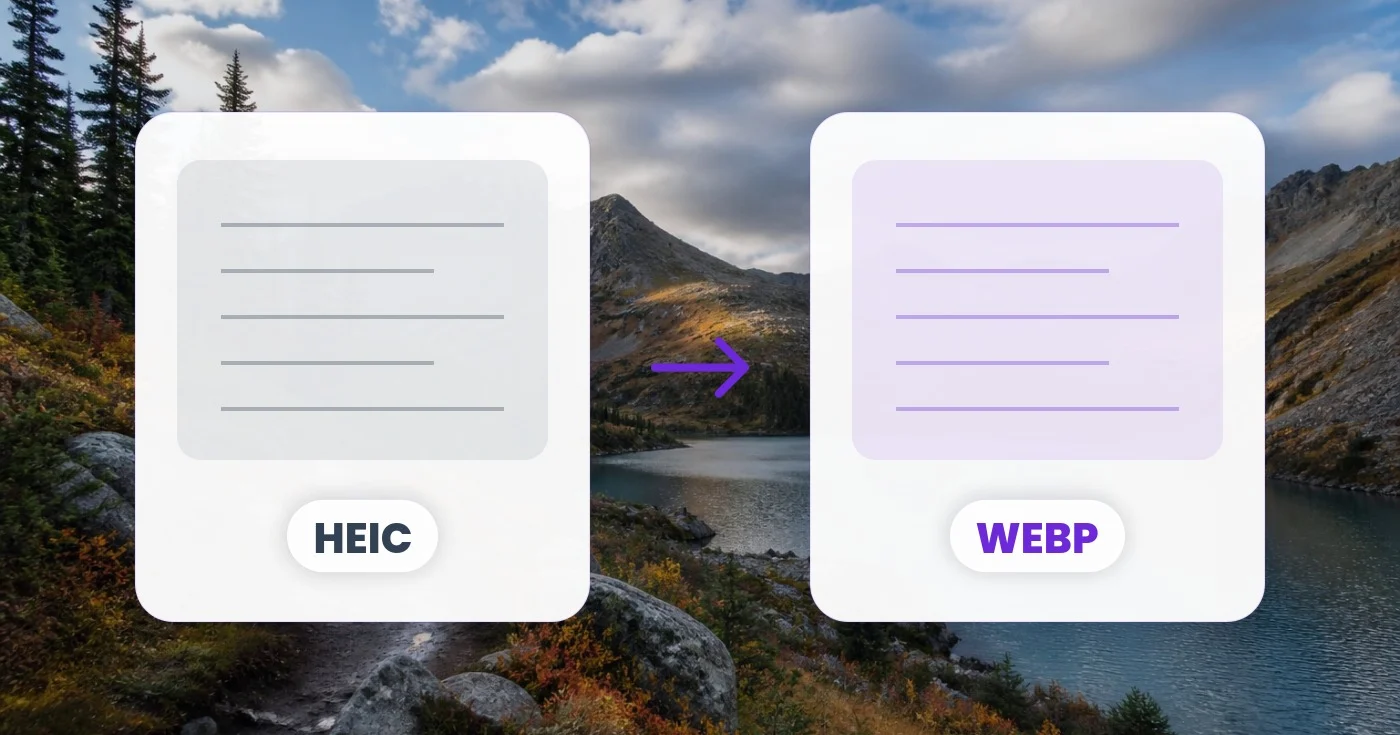
Every photo crosses the slash untouched and comes out the other side finished.