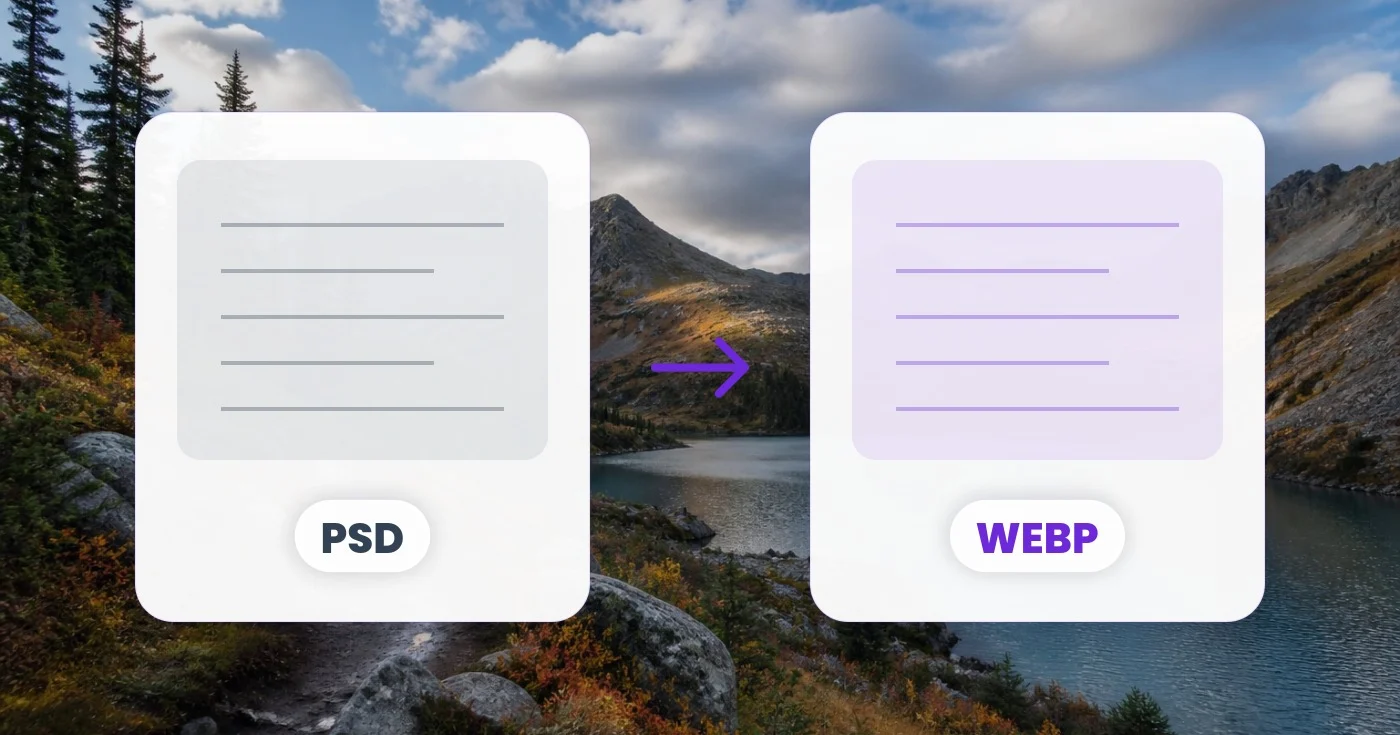
Convert PSD to WebP — Smaller Images for Faster Sites
Convert PSD to WebP online for smaller web images that keep transparency. No software to install. Preview one free or batch-convert with Premium.
Drop your PSD file or click to browse
Why convert PSD to WebP?
- WebP is supported far more widely than PSD, so the file is easier to open, share and upload.
- Transparent areas stay transparent: WebP supports smooth, partial transparency just like PSD.
- WebP is made for websites, online stores and blogs that need fast-loading images.
- No Photoshop needed: the file is opened on our servers and you download a ready-to-use WebP.
What to expect when converting PSD to WebP
- WebP uses lossy compression by default; raise the quality or switch on lossless in Settings for a closer copy.
- Layers are merged: you get the image as it looks with all visible layers combined.
PSD vs WebP
| Feature | PSD | WebP |
|---|---|---|
| Full name | Photoshop Document | WebP |
| Origin | Adobe Photoshop's native format since 1990 | Released by Google in 2010 |
| Compression | Lossless, with layers | Lossy or lossless |
| Transparency | Yes — smooth, partial transparency | Yes — smooth, partial transparency |
| Animation | No | Yes |
| Color | Up to 32 bits per channel, RGB or CMYK | 8 bits per channel |
| Where it opens | Photoshop and a few other editors; not browsers or phones | All current browsers; some older desktop apps and upload forms reject it |
| Best for | editing in Photoshop with layers, masks and effects intact | websites, online stores and blogs that need fast-loading images |
| Main drawback | large files that most apps can't open | older apps and some upload forms don't accept it |
In short: choose PSD for editing in Photoshop with layers, masks and effects intact; choose WebP for websites, online stores and blogs that need fast-loading images.
Preparing Photoshop designs for a website as WebP
Web designers and store owners often receive banners, hero images and product mockups as PSDs, then need files a site can load quickly. WebP fits that job: current browsers display it, it handles transparency, and its lossy mode usually produces smaller files than JPG for the same picture. The converter merges the visible layers of each PSD and encodes the result once, so there is no Photoshop export step for every image.
Two settings decide the outcome. The quality slider starts at 90, and its own hint suggests 60 to 80 for most photos; photographic banners often look nearly identical at those values in a much smaller file. Lossless mode keeps every pixel exactly, which suits flat-color graphics, icons and text-heavy banners, at the price of a bigger file. Transparent areas survive in both modes, so a cut-out product can sit directly on a colored section of the page.
WebP keeps the PSD's pixel dimensions, and a 5,000-pixel layout is wasted in a 1,200-pixel content column, so resize it to the display width, picking WebP as the output there, before publishing. It's also worth comparing an AVIF copy, which is often smaller still. Converting a whole folder of mockups? Premium batches up to 60 files at once and Pro up to 200, delivered as one ZIP. Some older programs and upload forms still reject WebP; for those, send a JPG.
Frequently asked questions
- How do I convert PSD to WebP?
- Upload your PSD file above. It is converted to WebP automatically (change the output format or quality in the Settings tab if you need to), then click Download. There is nothing to install.
- Does converting PSD to WebP lose quality?
- WebP is lossy by default, so some fine detail is discarded to make the file smaller. Raise the quality or switch on lossless in Settings for a closer copy.
- Will the WebP keep the transparent background?
- Yes. WebP supports smooth, partial transparency, so transparent areas stay transparent.
- PSD or WebP: which should I use?
- Use PSD for editing in Photoshop with layers, masks and effects intact. Use WebP for websites, online stores and blogs that need fast-loading images. Keep in mind the main drawback of WebP: older apps and some upload forms don't accept it.
- What is a PSD file?
- PSD keeps every Photoshop layer, mask and adjustment so a design stays editable. Outside Photoshop most apps can't show it, so a flattened copy is needed for sharing.
- Can I convert PSD to WebP without Photoshop?
- Yes. The PSD file is opened on our servers, so you don't need Photoshop or any other software installed. Upload the file, then download the finished WebP.
- Is the PSD to WebP converter free?
- Yes. Convert, preview and download a single result without creating an account. Premium adds batch conversion (many files into one ZIP) and larger uploads.
What you can do with PSD to WebP
Review the main capabilities before you begin.
- Convert PSD files to WebP online
- Choose WebP quality or switch to lossless
- Switch to any other output format in Settings
- Batch-convert many PSD files into one ZIP
- Preview the result before you download
Settings reference
5 settings
Available controls for PSD to WebP.
Settings
- Output formatDropdown
- Chooses the file type you download. The page opens on its own output format; switch to any other format before converting.Options: JPGPNGWebPAVIFGIFTIFFBMPICOPDF
- QualitySliderRange: 20–100 · Default: 90
- For JPG, WebP, AVIF and image-to-PDF output: higher keeps more detail but makes a bigger file; 60–80 suits most photos. Documents (Publisher, XPS, EPS…) become PDFs with every page and sharp text, with no quality setting.
- Lossless modeOn / Off
- For WebP and AVIF output: keeps every pixel exactly (best for logos, graphics and transparency) at the cost of a larger file.
- Background fillColor picker
- For JPG, BMP and image-to-PDF output, which can't store transparency: the color that fills transparent areas (white by default).
Mode
- Single file / BatchDropdown
- Process one file or a batch with shared settings. Batch results download as one ZIP.Options: Single fileBatch
Related tools for PSD to WebP
Tools for common next steps after PSD to WebP.
Image Conversion
PSD to JPG
Convert PSD files to JPG. Review and download the converted image.
Try it now
Image Conversion
PSD to PNG
Convert PSD files to PNG. Review and download the converted image.
Try it now
Image Conversion
Image Format Converter
Convert between supported PNG, JPG, WebP, AVIF and GIF formats, then review and download the result.
Try it nowWatch each transformation land
Every photo crosses the slash untouched and comes out the other side finished.