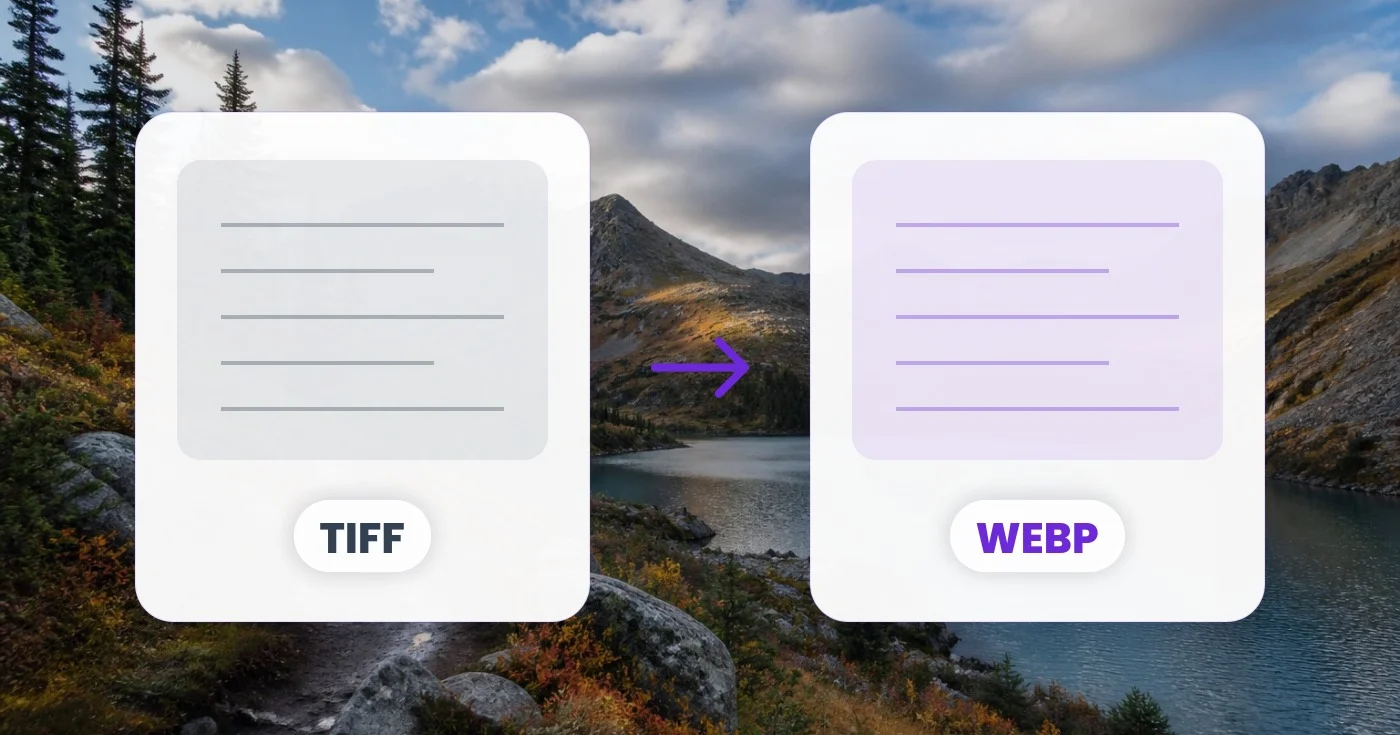
Convert TIFF to WebP — Smaller Images for Faster Sites
Convert TIFF to WebP online for smaller web images that keep transparency. No software to install. Preview one free or batch-convert with Premium.
Drop your TIFF file or click to browse
Why convert TIFF to WebP?
- WebP files are usually smaller than TIFF for the same picture, so pages load faster and uploads finish sooner.
- Transparent areas stay transparent: WebP supports smooth, partial transparency just like TIFF.
- WebP is made for websites, online stores and blogs that need fast-loading images.
What to expect when converting TIFF to WebP
- WebP uses lossy compression by default; raise the quality or switch on lossless in Settings for a closer copy.
- Only the first page of a multi-page TIFF is converted, and CMYK print color becomes standard RGB.
TIFF vs WebP
| Feature | TIFF | WebP |
|---|---|---|
| Full name | Tagged Image File Format | WebP |
| Origin | Created by Aldus in 1986, now maintained by Adobe | Released by Google in 2010 |
| Compression | Lossless (LZW) or uncompressed | Lossy or lossless |
| Transparency | Yes — smooth, partial transparency | Yes — smooth, partial transparency |
| Animation | No | Yes |
| Color | Up to 16 bits per channel, RGB or CMYK | 8 bits per channel |
| Where it opens | Photo editors, print and scanning software; most browsers don't display it | All current browsers; some older desktop apps and upload forms reject it |
| Best for | print production, scanning and long-term archiving | websites, online stores and blogs that need fast-loading images |
| Main drawback | very large files that web browsers won't display | older apps and some upload forms don't accept it |
In short: choose TIFF for print production, scanning and long-term archiving; choose WebP for websites, online stores and blogs that need fast-loading images.
Publishing TIFF masters on the web as WebP
Photographers and studios keep TIFF masters for print, then need web versions of the same images for a portfolio, a shop or a press page. WebP is that web copy: browsers display it and it usually takes far less space than the TIFF it came from.
Lossy WebP at the default quality of 90 suits photographs, and the slider's hint suggests 60 to 80 for most photos when pages need to be lighter. Turn on Lossless mode for artwork, scanned drawings and anything with fine text, where an exact copy matters more than size. A transparent TIFF keeps its transparency in WebP, and CMYK files come out in RGB, the color space screens use.
Print masters are usually far larger in pixels than a web page needs, so scale each image down to its display width, with WebP chosen as the output there. For clients who still want JPG, make a JPG version for the web.
Frequently asked questions
- How do I convert TIFF to WebP?
- Upload your TIFF file above. It is converted to WebP automatically (change the output format or quality in the Settings tab if you need to), then click Download. There is nothing to install.
- Does converting TIFF to WebP lose quality?
- WebP is lossy by default, so some fine detail is discarded to make the file smaller. Raise the quality or switch on lossless in Settings for a closer copy.
- Will the WebP keep the transparent background?
- Yes. WebP supports smooth, partial transparency, so transparent areas stay transparent.
- TIFF or WebP: which should I use?
- Use TIFF for print production, scanning and long-term archiving. Use WebP for websites, online stores and blogs that need fast-loading images. Keep in mind the main drawback of WebP: older apps and some upload forms don't accept it.
- What is a TIFF file?
- TIFF is the workhorse of print and archiving. It keeps every pixel without loss and is accepted by print shops, publishers and document-management systems.
- Is the TIFF to WebP converter free?
- Yes. Convert, preview and download a single result without creating an account. Premium adds batch conversion (many files into one ZIP) and larger uploads.
What you can do with TIFF to WebP
Review the main capabilities before you begin.
- Convert TIFF files to WebP online
- Choose WebP quality or switch to lossless
- Switch to any other output format in Settings
- Batch-convert many TIFF files into one ZIP
- Preview the result before you download
Settings reference
5 settings
Available controls for TIFF to WebP.
Settings
- Output formatDropdown
- Chooses the file type you download. The page opens on its own output format; switch to any other format before converting.Options: JPGPNGWebPAVIFGIFTIFFBMPICOPDF
- QualitySliderRange: 20–100 · Default: 90
- For JPG, WebP, AVIF and image-to-PDF output: higher keeps more detail but makes a bigger file; 60–80 suits most photos. Documents (Publisher, XPS, EPS…) become PDFs with every page and sharp text, with no quality setting.
- Lossless modeOn / Off
- For WebP and AVIF output: keeps every pixel exactly (best for logos, graphics and transparency) at the cost of a larger file.
- Background fillColor picker
- For JPG, BMP and image-to-PDF output, which can't store transparency: the color that fills transparent areas (white by default).
Mode
- Single file / BatchDropdown
- Process one file or a batch with shared settings. Batch results download as one ZIP.Options: Single fileBatch
Related tools for TIFF to WebP
Tools for common next steps after TIFF to WebP.
Image Conversion
TIFF to JPG
Convert TIFF images to JPG with orientation handling and adjustable export quality.
Try it now
Image Conversion
TIFF to PNG
Convert TIFF files to PNG. Review and download the converted image.
Try it now
Image Conversion
Image Format Converter
Convert between supported PNG, JPG, WebP, AVIF and GIF formats, then review and download the result.
Try it nowWatch each transformation land
Every photo crosses the slash untouched and comes out the other side finished.